
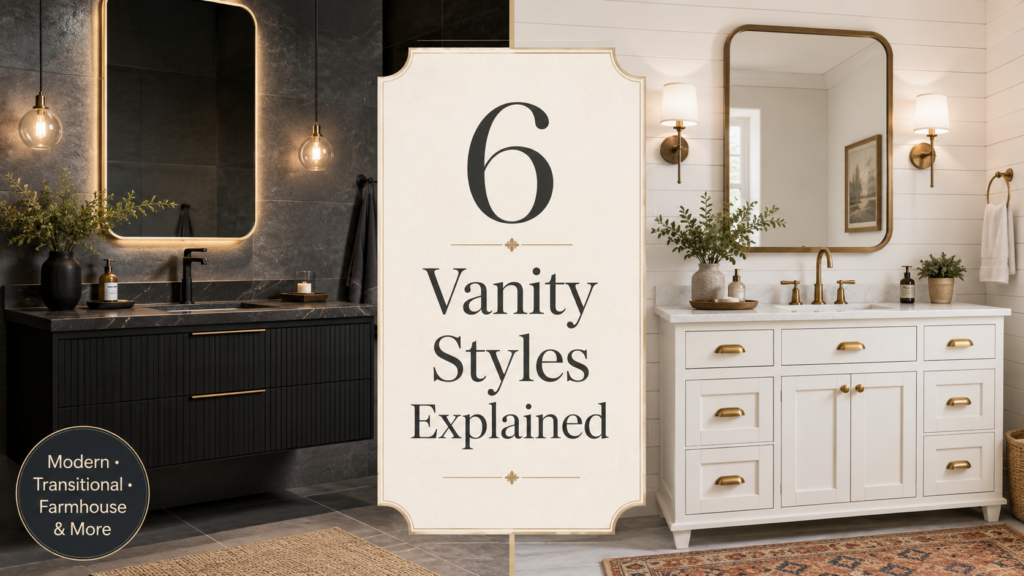
Quick Summary
- Bathroom vanities are the visual anchor of any bathroom, making style selection one of the most important decisions in a renovation project.
- Modern vanities feature flat-front slab doors, minimal hardware, clean lines, and are ideal for contemporary homes and smaller spaces.
- Transitional vanities blend modern simplicity with traditional warmth, making them the most versatile and widely preferred style among homeowners.
- Farmhouse vanities emphasize natural materials, furniture-style details, and vintage-inspired finishes that create warmth and character.
- Traditional vanities showcase raised-panel cabinetry, decorative molding, and rich finishes that suit formal and historic homes.
- Scandinavian vanities combine minimalist design with light wood tones and natural materials to create bright, calming spaces.
- Industrial vanities incorporate raw materials such as metal, concrete, and reclaimed wood for a bold urban aesthetic.
- Choosing the right vanity style depends on your home’s architecture, bathroom size, maintenance preferences, and long-term design goals.
- Transitional and modern vanity styles generally offer the strongest resale appeal due to their broad market acceptance.
- Mixing complementary styles can create a balanced design, but successful results require one style to dominate while the other serves as an accent.
- Floating modern and Scandinavian vanities are often the best choices for small bathrooms because they create the illusion of additional space.
- The best vanity style is one that aligns with your home’s overall design, supports your lifestyle needs, and remains visually appealing for years to come.
Choosing a bathroom vanity is one of the most impactful decisions you can make in a bathroom renovation. The vanity sets the visual tone for the entire space and with so many styles available, it’s easy to feel overwhelmed trying to figure out which one is right for your home.
Modern? Transitional? Farmhouse? Scandinavian? Each style speaks a completely different design language, and choosing the wrong one for your bathroom’s existing architecture creates a visual mismatch that even the best accessories can’t fix.
This complete guide breaks down every major bathroom vanity style what defines it, which bathroom types it suits, what hardware and finishes to pair with it, and how to shop smart. By the end, you’ll know exactly which style belongs in your bathroom.
Did You Know? According to Grand View Research, the global bathroom vanities market was valued at USD 43.34 billion in 2024 and is projected to reach USD 65.55 billion by 2030. In terms of consumer preference, around 79% of buyers lean toward modern-style vanities making style selection more important than ever for long-term satisfaction. Source:
Grand View Research – Bathroom Vanities Market Report
What You’ll Learn in This Guide
- The defining characteristics of 6 major bathroom vanity styles
- Hardware, finishes, counter top, and cabinet pairings for each style
- Which bathroom types and home architectures each style suits best
- Pro tips for mixing styles without creating visual chaos
- How to shop for the right vanity with confidence
Why Getting the Vanity Style Right Actually Matters
A bathroom vanity is typically the largest single piece of furniture in the bathroom. It’s the visual anchor everything else mirrors, lighting, tile, hardware is styled around. A modern floating vanity in a bathroom with traditional raised-panel wainscoting and ornate mirrors creates immediate visual friction. A heavily carved traditional vanity in a sleek, minimalist space can make the room feel confused and unfinished.
Style isn’t just decoration. It’s structural to how a room reads. Getting it right makes every other design decision easier and getting it wrong is the reason so many renovations “don’t feel quite right” even when the materials and execution are flawless.
1. Modern Bathroom Vanity Style
What Defines It
Modern design is built on a philosophy of “form follows function.” Every detail serves a purpose, and ornamentation for its own sake is eliminated entirely. If it doesn’t do something, it doesn’t belong.
In a modern bathroom vanity, you’ll see clean horizontal and vertical lines with no curves or molding. Cabinet doors are flat-front slab no raised panel, no recessed panel so the door face is one unbroken, flat surface. Hardware, when it appears at all, is a thin bar pull or integrated touch-to-open mechanism. Never a traditional knob.
Signature Design Details
- Cabinet lines: Strictly flat-front slab, no panel profiles
- Hardware: Minimal bar pulls, integrated grooves, or handleless push-to-open
- Finishes: Matte black, brushed nickel, white lacquer, concrete gray cool-toned and consistently matte
- Countertops: Quartz, concrete, or integrated sink; square-edge profiles only
- Mounting: Wall-mounted (floating) is the most common and most authentic to the style
- Color palette: White, gray, black, muted charcoal almost always monochromatic
Best Suited For
- New construction or fully gut-renovated bathrooms
- Homes with contemporary or mid-century modern architecture
- Smaller bathrooms where floating vanities visually enlarge the space
- Anyone who wants a timeless, easy-to-maintain aesthetic
Pro Tip: A floating (wall-mounted) modern vanity instantly makes any bathroom feel larger because the exposed floor underneath creates the illusion of more space. Browse our
wall-mounted vanity collection to find the right fit.
Outdated vanity. Wasted space. Not anymore.
Upgrade the room you use every single day.
Shop the 2026 Bathroom Collection →
🚚 Free shipping on orders within 120 miles of York, PA | (877) 395-6050
2. Transitional Bathroom Vanity Style
What Defines It
Transitional is the most popular vanity style in North America and for good reason. It bridges the gap between traditional warmth and modern restraint, creating a look that’s clean and current without feeling cold or clinical. If you can’t decide between modern and traditional, you’re probably describing transitional.
The transitional vanity has a slightly softer silhouette than modern. You’ll often see a subtle Shaker-style door (a simple recessed center panel with flat-rail frame) it has some architecture, but nothing ornate. Lines are cleaner than traditional but not as strict as modern. There’s a sense of quiet refinement.
Signature Design Details
- Cabinet lines: Shaker-style door with simple recessed panel understated, not decorative
- Hardware: Simple bar pulls or cup pulls in satin brass, matte black, or brushed nickel
- Finishes: White, soft gray, warm linen, light wood tones warmer than modern
- Countertops: Quartz or marble-look quartz; square or slightly eased edge profiles
- Mounting: Both freestanding and floating work well depending on the space
- Color palette: Warm whites, soft grays, greige, light oak, navy
Best Suited For
- Existing homes being updated, not fully renovated
- Bathrooms with mixed design cues some traditional trim, some modern fixtures
- Anyone who wants flexibility to redecorate over time without the vanity looking dated
- Resale: transitional is the most broadly appealing style to home buyers
Style Note: The key difference between modern and transitional comes down to one thing: the door. Modern = flat slab. Transitional = Shaker recessed panel. Everything else (hardware, finish, countertop) can overlap.
3. Farmhouse Bathroom Vanity Style
What Defines It
The farmhouse style brings warmth, texture, and a sense of lived-in character to the bathroom. It draws from the practical, unpretentious interiors of American and European farm homes natural materials, distressed finishes, open shelving, and vintage-inspired hardware. The aesthetic feels collected over time rather than designed all at once.
A farmhouse vanity often features furniture-style legs (it looks like a piece of freestanding furniture converted for bathroom use), natural wood tones or painted finishes in muted colors, apron-front or vessel sinks, and hardware in oil-rubbed bronze, antique brass, or aged iron.
Signature Design Details
- Cabinet style: Open shelving, furniture-style legs, or a vintage dresser conversion
- Hardware: Oil-rubbed bronze, antique brass, aged iron never chrome
- Finishes: Distressed white, barn wood gray, sage green, navy, warm cream
- Countertops: Butcher block, honed marble, soapstone, or undermount farmhouse sink
- Accents: Shiplap walls, barn-style mirror frames, wicker baskets, cotton towels
- Sink style: Apron-front, drop-in porcelain, or vintage vessel
Best Suited For
- Homes with rustic, craftsman, or cottage architecture
- Country homes, lake houses, or homes with natural material palettes
- Anyone who loves warmth, texture, and character over sleek minimalism
Interesting Fact: According to Houzz, the classic “farmhouse bathroom” is somewhat of a design paradox. Most original American farmhouses didn’t have indoor bathrooms at all — when plumbing was finally brought inside, homeowners simply converted a spare bedroom into a washroom, which is why authentic farmhouse bathrooms have that “room within a room” quality. This functional, unfussy origin is what drives the style’s enduring popularity today. Source: Houzz – 8 Elements of a Farmhouse-Style Bathroom
4. Traditional Bathroom Vanity Style
What Defines It
Traditional bathroom vanities are the most architecturally detailed of all the styles. They draw from classic European design particularly 18th and 19th century cabinetry and feature raised panel doors, decorative molding, carved feet, and rich wood tones or painted finishes in jewel-like hues.
Traditional vanities feel substantial, almost furniture-like in their presence. They work beautifully in formal or historic homes but can feel heavy in small or contemporary spaces.
Signature Design Details
- Cabinet style: Raised-panel doors with detailed molding and decorative corbels
- Hardware: Ornate knobs or bin pulls in polished chrome, antique brass, or oil-rubbed bronze
- Finishes: Cherry, mahogany, espresso, dark walnut, or painted deep colors
- Countertops: Marble, granite, or cultured stone with an ogee or bullnose edge profile
- Legs or feet: Carved feet or furniture-style base with visible detail
- Mirrors: Framed in matching wood or ornate gilded frame
Best Suited For
- Formal or historic homes (Victorian, Colonial, Federal-style architecture)
- Master bathrooms where a statement piece is desired
- Homeowners who prefer richness and permanence over minimalism
5. Scandinavian & Minimalist Bathroom Vanity Style
What Defines It
Scandinavian design shares DNA with modern but brings a warmer, more organic sensibility. Where modern leans cold and architectural, Scandinavian leans toward warmth through the use of natural materials particularly light wood, white, and muted natural tones. The philosophy is “less but better.”
A Scandinavian vanity will often pair a flat-front slab door (like modern) with light oak or birch wood tones, simple integrated hardware, and a white or light stone countertop. The result is clean and calm a bathroom that feels like a breath of fresh air.
Signature Design Details
- Cabinet style: Flat-front slab, often with visible wood grain
- Hardware: Integrated grooves, thin brushed brass or steel pulls
- Finishes: White, light oak, birch, ash, warm sand
- Countertops: White quartz, light concrete, or stone with a simple square edge
- Accents: Plants, natural fiber baskets, soft linen towels, matte ceramic vessels
Best Suited For
- Small to medium bathrooms the light palette maximizes perceived space
- Apartments and condos
- Anyone who loves modern restraint but wants more warmth
6. Industrial Bathroom Vanity Style
What Defines It
Industrial bathroom design borrows from the raw, utilitarian aesthetic of factories and lofts exposed metal, raw wood, concrete, and an intentional “unfinished” quality that feels edgy and urban. It’s a bold choice, best suited to spaces that fully commit to the aesthetic.
Industrial vanities often combine metal pipe-style legs or frames with reclaimed wood or concrete tops. Black matte hardware, vessel sinks in concrete or matte ceramic, and Edison bulb lighting are hallmarks of the style.
Signature Design Details
- Cabinet style: Open steel frame with reclaimed wood shelves, or concrete-look finish
- Hardware: Black matte or dark gunmetal always industrial, never polished
- Finishes: Raw concrete, reclaimed wood, dark walnut, charcoal gray
- Countertops: Poured concrete, honed black slate, or dark stone
- Accents: Exposed pipes, Edison bulb vanity lights, metal towel bars
Best Suited For
- Urban lofts, converted warehouse homes, modern apartments
- Spaces with exposed brick, concrete floors, or steel elements
- Bold, adventurous design personalities
Quick Comparison: All 6 Bathroom Vanity Styles at a Glance
Use this reference table to compare key design elements across every style:
| Style | Door Type | Hardware | Finish | Countertop | Best For |
|---|---|---|---|---|---|
| Modern | Flat slab | Bar pull / handleless | Matte black, white lacquer | Quartz / concrete | New builds, contemporary homes |
| Transitional | Shaker recessed | Bar pull / cup pull | Soft white, gray, greige | Quartz / marble-look | Resales, mixed-style homes |
| Farmhouse | Open shelf / legs | Oil-rubbed bronze | Distressed white, sage, navy | Butcher block / honed marble | Rustic / cottage homes |
| Traditional | Raised panel | Ornate knob / bin pull | Cherry, espresso, jewel tones | Marble / granite with ogee edge | Historic / formal homes |
| Scandinavian | Flat slab + wood | Thin brushed pulls | White, light oak, birch | White quartz / light stone | Small spaces, apartments |
| Industrial | Open frame / slab | Matte black / gunmetal | Concrete, reclaimed wood | Poured concrete / dark slate | Lofts, urban spaces |
How to Choose the Right Vanity Style for Your Bathroom
With six styles on the table, how do you narrow it down? Use these four questions to guide your decision:
1. What is Your Home’s Architectural Style?
Your bathroom doesn’t exist in isolation. If your home has traditional crown molding, raised-panel interior doors, and colonial trim, a farmhouse or traditional vanity will feel harmonious. A sleek modern or industrial vanity will create jarring contrast. Match the vanity’s design language to the home’s existing vocabulary.
2. What Is the Bathroom’s Square Footage?
Smaller bathrooms benefit from lighter, visually clean styles modern floating, Scandinavian, or transitional. Traditional and farmhouse styles with heavy bases and dark finishes can make small spaces feel cramped. If you have a small bathroom but love farmhouse style, go with a lighter painted finish and legs-style vanity rather than a heavy closed cabinet.
3. What Is Your Maintenance Tolerance?
Farmhouse and traditional styles with distressed finishes and natural wood age beautifully but require more care. Modern and Scandinavian styles with lacquer finishes and quartz countertops are extremely easy to clean and maintain. If ease of maintenance is a priority, lean modern or transitional.
4. Are You Planning to Sell in the Next 5 Years?
If resale value is a consideration, transitional is your safest bet it’s the most broadly appealing style to buyers across demographics. Modern is also strong. Highly personalized styles (heavy traditional, full industrial) may appeal strongly to some buyers and put others off.
Can You Mix Bathroom Vanity Styles? (And How to Do It Right)
Yes but with intention. The most successful bathrooms often blend two adjacent styles rather than committing rigidly to one. Here are the combinations that work:
- Modern + Scandinavian: Add warmth to a modern space with light wood accents, plants, and natural fiber accessories. The flat-front slab vanity works for both.
- Transitional + Farmhouse: Use a Shaker-door vanity in a warm painted finish (sage, navy, warm white) and pair with vintage-inspired hardware. The result is fresh farmhouse.
- Transitional + Traditional: Choose a transitional vanity as the anchor and add traditional elements in the mirror frame, lighting, or tile. The mix reads as “updated traditional.”
- Avoid: Modern + Heavy Traditional. The contrast is too stark and reads as unresolved.
- Avoid: Industrial + Farmhouse. Both are strong aesthetics that compete rather than complement.
Design Rule: When mixing styles, let one dominate (70%) and use the other as an accent (30%). This creates intentional contrast rather than visual confusion.
Did You Know? The National Kitchen & Bath Association (NKBA) 2025 Bath Trends Report — based on feedback from 500 industry professionals across North America — identifies wellness, spa-like features, and minimal upkeep as the primary design priorities shaping bathroom renovations through 2027. These priorities align most strongly with modern and transitional vanity styles, which offer clean surfaces, minimal hardware, and easy maintenance. Source:
Frequently Asked Questions: Bathroom Vanity Styles
Q1: What is the most popular bathroom vanity style in the United States?
Transitional is consistently the most purchased bathroom vanity style in the US, largely because it bridges modern and traditional aesthetics making it broadly appealing to homeowners, designers, and buyers alike. Modern vanities are the second most popular, particularly in new construction and fully renovated bathrooms.
Q2: What is the difference between a modern and transitional bathroom vanity?
The most clear-cut difference is the cabinet door. A modern vanity features a flat-front slab door completely unadorned, no panel profiles. A transitional vanity typically uses a Shaker-style door with a simple recessed center panel. Both styles favor clean lines and minimal hardware, but transitional allows for warmer finishes (soft gray, greige, warm white, light wood) while modern stays strictly cool-toned and monochromatic.
Q3: Is farmhouse style still popular for bathrooms in 2025?
Farmhouse bathroom style peaked in popularity between roughly 2016 and 2021 driven by the HGTV shiplap-and-barn-door era. As of 2025, the style is transitioning. Heavily replicated elements like apron-front sinks with all-white shaker cabinets are feeling dated, but updated farmhouse incorporating bolder colors (sage, navy, terracotta), furniture-style vanity legs, and warm unlacquered brass hardware is absolutely still a strong, viable choice for the right home.
Q4: What vanity style is best for a small bathroom?
For small bathrooms, modern floating vanities are the clear winner. The wall-mounted design leaves floor space exposed beneath the vanity, creating the visual illusion of a larger room. Scandinavian-style vanities in light wood and white are another excellent option. Avoid heavy traditional or farmhouse styles with closed bases in small bathrooms they tend to visually shrink the space.
Q5: What is a transitional bathroom vanity exactly?
A transitional bathroom vanity is one that intentionally blends elements of both modern and traditional design without committing fully to either. It typically features simple Shaker-style cabinet doors, clean lines without excessive ornamentation, hardware in versatile finishes like matte black or brushed nickel, and a countertop in quartz or marble-look quartz. The result is a vanity that is simultaneously fresh, timeless, and adaptable.
Q6: Can I use a modern vanity in an older or traditional home?
Yes, but with careful planning. A modern floating vanity can actually work beautifully as a deliberate contrast piece in a traditional home — if the rest of the bathroom supports it. The key is to commit to the contrast rather than mix accidentally. If your home has strong traditional architecture, transitional is often the safer choice as it bridges both worlds without friction.
Q7: What countertop material works best with a modern vanity?
Quartz is the most practical and popular countertop for modern vanities it is non-porous, low-maintenance, and available in clean, consistent colors that suit the modern aesthetic. Concrete or poured concrete is a bolder option for industrial-modern spaces. For a slightly warmer modern look, honed marble or white marble-look quartz with a square edge works well. Avoid ogee or bullnose edge profiles on countertops paired with modern vanities — the detail conflicts with the clean-line philosophy.
Q8: What is the difference between a farmhouse vanity and a rustic vanity?
Farmhouse and rustic often overlap, but there is a distinction. Farmhouse style draws from the practical interiors of American and European farm homes — it is warm and textured but still relatively tidy and livable. Rustic style is more raw and primitive — exposed logs, rough-hewn wood, dark natural stone, and very little polish. A farmhouse vanity might be a painted furniture-style piece with vintage hardware. A rustic vanity would more likely be a live-edge slab or reclaimed wood with iron pipe legs. Both use natural materials, but farmhouse is more refined.
Final Thoughts: Choosing a Vanity Style You’ll Love for Years
There’s no wrong bathroom vanity style only the wrong style for your specific bathroom, home, and lifestyle. The most important thing is intentionality: choosing a style based on your home’s architecture, your aesthetic values, and your practical needs rather than simply following a trend.
Modern vanities reward those who love simplicity and easy maintenance. Transitional styles serve those who want timeless flexibility. Farmhouse and traditional styles reward those who love character and warmth. Scandinavian suits those who want nature’s calm brought indoors. Industrial suits those who want bold, urban edge.
Whatever style you choose, invest in quality. A well-made vanity in any style will serve you beautifully for decades.